
Australian Tax Brackets 2026–27: What Will You Actually Pay?
Tax brackets are one of those things most of us vaguely understand until our income changes and suddenly we find ourselves Googling, “What tax bracket am I in?”
Maybe you've had a pay rise, changed jobs, started earning income from somewhere else, or your business has had a particularly good year. Whatever brought you here, understanding the Australian tax brackets for 2026–27 is actually pretty straightforward once you get past all the percentages.
There has also been a change for the 2026–27 financial year, so if you're looking at an old tax table, there's a good chance it isn't quite right anymore.
Australian tax brackets for 2026–27
For Australian residents for tax purposes, the individual income tax rates for 2026–27 are:
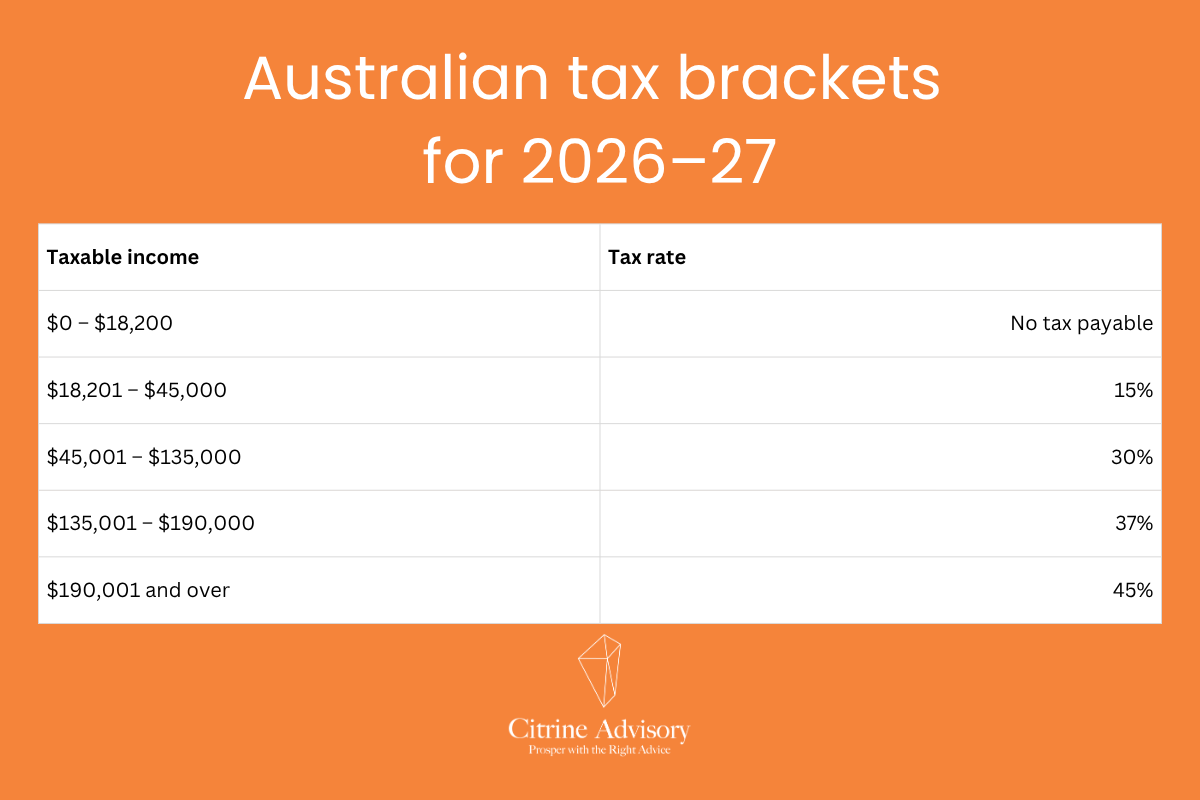
From 1 July 2026, the rate applying to taxable income between $18,201 and $45,000 reduced from 16% to 15%. These rates don't include the Medicare levy, and your actual tax position can depend on a number of other things as well.
First, let's clear up the biggest misunderstanding about tax brackets
One of the things we hear surprisingly often is someone worrying that earning a little more will push them into the next tax bracket and they'll somehow end up worse off.
Thankfully, that's not how Australian tax brackets work.
Australia has a marginal tax system, which basically means different portions of your income are taxed at different rates. If your taxable income is $100,000, for example, you aren't paying 30% tax on the entire $100,000.
The first $18,200 is tax free. The portion between $18,201 and $45,000 is taxed at 15%, and it's only the portion above $45,000 that falls into the 30% bracket.
The same thing happens as your income moves through the higher brackets. If your taxable income creeps just over $135,000, you don't suddenly pay 37% tax on everything you've earned. That higher rate only applies to the portion sitting above the threshold.
So if you've been offered a pay rise and someone has told you not to take it because you'll “lose it all in tax”, please don't make that decision based on the tax bracket alone.
What's changed for the 2026–27 financial year?
The main change this financial year is to that lower tax bracket. From 1 July 2026, the rate applying to taxable income between $18,201 and $45,000 dropped from 16% to 15%.
A further legislated reduction to 14% is due from 1 July 2027.
It isn't a dramatic overhaul of the tax system, but it does mean it's worth making sure you're looking at the right financial year's rates when you're trying to estimate your tax.
Your salary and your taxable income aren't necessarily the same thing
This is another area where people can get confused. The number on your employment contract isn't necessarily the number we ultimately calculate your tax on because your taxable income is what matters, and that can include much more than your salary.
Depending on your circumstances, you might also have income from investments, a rental property, shares, a trust or a business. There may also be allowable deductions that reduce your taxable income.
If you're running a business, your tax position can become more complicated again because the way your business is structured can affect how income and tax are dealt with. We've explained some of the differences in our guide to choosing the right business structure.
This is why two people earning what looks like the same amount on paper can end up with quite different tax outcomes.
Don't forget about the Medicare levy
The percentages in the table above aren't necessarily the end of the calculation either.
Most Australian taxpayers also pay the Medicare levy, generally calculated at 2% of taxable income, although reductions and exemptions can apply depending on your circumstances.
There is also the Medicare Levy Surcharge, which is a separate thing altogether and can apply to some higher-income earners who don't have an appropriate level of private hospital cover.
This is where trying to calculate your exact tax bill from a tax-bracket table starts becoming a little less useful. Your bracket tells you the rate applying to that portion of your income, but it doesn't tell you what your entire tax position will look like.
Earning more? This is where we'd start looking beyond the table
If your income has increased significantly, knowing which tax bracket you're in is useful, but we'd be looking at much more than that.
You might have investment income, shares, property, capital gains, additional super contributions, a family trust or business interests. Perhaps you've received a large bonus, sold an asset or you're expecting your income to look very different this year.
That's where tax planning and good advice become much more valuable than simply knowing your marginal tax rate.
At Citrine, we'd much rather have that conversation with you during the financial year while there may still be decisions to make. Waiting until your tax return is being prepared can mean we're looking backwards at things that have already happened rather than planning ahead.
We've talked about this before in Planning Ahead vs Reacting in June, because some of the most useful tax conversations happen well before the end of the financial year.
Tax planning isn't about finding clever loopholes or doing anything questionable. It's about understanding your position properly, knowing what legitimate options are available to you and making good decisions while you still have the opportunity to make them.
So, how much tax will you actually pay in 2026–27?
The tax brackets give you a starting point, but they aren't enough to tell you exactly what your final tax bill will be.
Your taxable income, deductions, offsets, Medicare levy, investments, capital gains and other circumstances can all affect the final result. The amount of tax already withheld throughout the year will also affect whether you end up receiving a refund or having an amount to pay when your return is lodged.
That's why we don't love looking at someone's income and simply saying, “You're in the 37% bracket.” It doesn't tell us enough about what's actually happening.
If you want to understand more about tax, business and the other things we regularly get asked about, we've built the Citrine Knowledge Hub as a place where we explain this stuff without making it unnecessarily complicated.
Need help making sense of your tax?
If you've landed here because your income has changed or you've realised your tax situation isn't quite as straightforward as it used to be, that's exactly the sort of thing we're here for.
Citrine Advisory works with individuals, families, high-income earners and business owners across Melbourne and wider Victoria. We can help with the tax return at the end of the year, of course, but we're also big believers in having the conversation earlier when there's actually an opportunity to plan.
If you're looking for a tax accountant in Melbourne or simply want to understand what the 2026–27 tax brackets mean for your own circumstances, come and have a chat with us.
Talk to Citrine about your tax.
This article contains general information only and doesn't take your personal circumstances into account. For advice specific to your business, speak with a registered tax agent. Our team is available for a free no obligation discovery call.